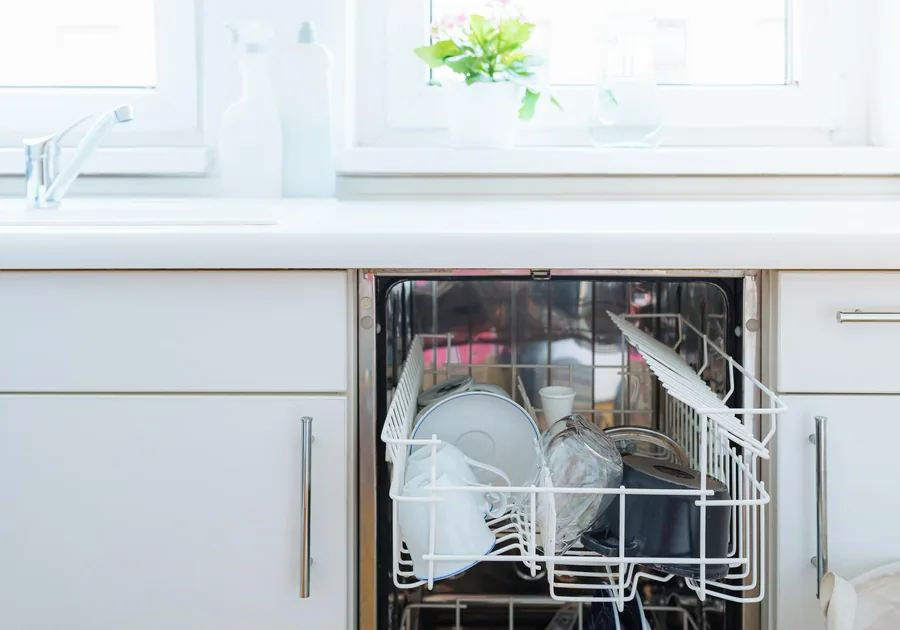
This is the complaint we hear most about dishwashers and the one least likely to need a part. Modern machines dry very differently from the ones people remember, and most of the disappointment traces back to that rather than to a problem.
What changed
Older dishwashers dried with an exposed heating element in the base. Efficiency rules pushed manufacturers away from that, and most now use condensation drying: the final rinse comes out hot, the stainless tub stays cool, and moisture condenses on the walls instead of on your plates. It works, but only if you let it.
The three approaches that undo it
- Opening the door straight away. Condensation drying needs the door shut for the cool-down. Open it at the beep and you have vented the process. Leave it thirty minutes.
- Skipping rinse aid. It is not a luxury on these machines. It breaks the surface tension so water sheets off rather than beading, and without it plastics in particular stay soaked.
- Loading plastics on the bottom. Plastic holds no heat, so it cannot evaporate what sits on it. Top rack, angled.
When it is actually the machine
If all three are right and everything still comes out wet, the machine is probably not reaching temperature. On a condensation dryer that means the water heater circuit or the thermistor telling it when to stop. On a machine with a vent fan it can also be the vent flap sticking shut.
A quick test: run a cycle and open the door two minutes after the wash phase starts. If the water is not clearly hot, the heat is the problem rather than the drying.
Hard water hides in this too
Across much of the north suburbs the water is hard enough to leave film on glass that reads as wet. If your glasses are cloudy as well as damp, treat the scale first and judge the drying afterwards.
Call (847) 555-0142.